
Commercial Roofing Services
Roof Recover & Overlay in Winston-Salem, NC
Recover and Overlay Assessment for Winston-Salem Roofs
Recover means installing a new roof assembly over an existing one that's still structurally sound, rather than tearing the old system off first, and it's the option that saves an owner the most money when the underlying deck and insulation qualify. It's also the option most often oversold by contractors who skip the assessment step, which is why every recover proposal we write starts with data, not a visual estimate from the ground.
What Has to Be True for Recover to Be Viable
Three conditions have to hold before we'll propose a recover instead of tear-off: the deck has to test structurally sound, the existing insulation has to test dry through core samples, and the existing roof's layer count has to fall within what North Carolina's building code allows to remain in place before a new layer is added. Any one of these failing rules out recover regardless of how the roof looks from the parking lot.
We pull permit history where it's available to establish prior roof work, and where records don't exist or don't match what we find in the field, the core samples become the record of layer count instead.
Insulation Crush Testing
Beyond moisture, we check whether existing insulation can support a new membrane system without crushing or compressing under foot traffic and mechanically fastened attachment, which matters more on older or lower-density insulation board than owners typically expect. Compressed insulation reduces both R-value and the new membrane's fastener pull-out resistance, so this test result factors directly into whether we recommend recover or a tear-off with fresh insulation instead.
- Existing layer count confirmed against North Carolina building code limits
- Deck structural condition assessed for added dead load if applicable
- Insulation moisture checked via core samples at multiple roof zones
- Insulation crush resistance tested against new membrane attachment requirements
- Cover board specified to separate new membrane from existing surface irregularities
- Manufacturer warranty tier confirmed for the specific recover assembly
Code Limits on Roof Layers
Building code sets a maximum number of roof layers that can remain on a structure before a full tear-off is required regardless of substrate condition, which means a roof that's already been recovered once may already be at its limit. We confirm layer count before quoting recover as an option at all, since proposing a recover on a roof that's already at the code maximum isn't a cost-saving measure, it's a compliance problem waiting to surface at inspection or resale.
Financial Case for Recover vs. Full Replacement
Recover typically costs less than tear-off and replacement because it eliminates demolition labor, disposal cost, and the schedule risk of an exposed deck during installation, which matters especially on occupied buildings, manufacturing floors and medical offices among them, where minimizing downtime carries its own value beyond the roofing invoice itself. We lay out both options side by side in the proposal when a roof genuinely qualifies for either, so the owner is deciding with full cost and risk information rather than being steered toward whichever option is easier to sell.
Typical Recover Assembly Configurations
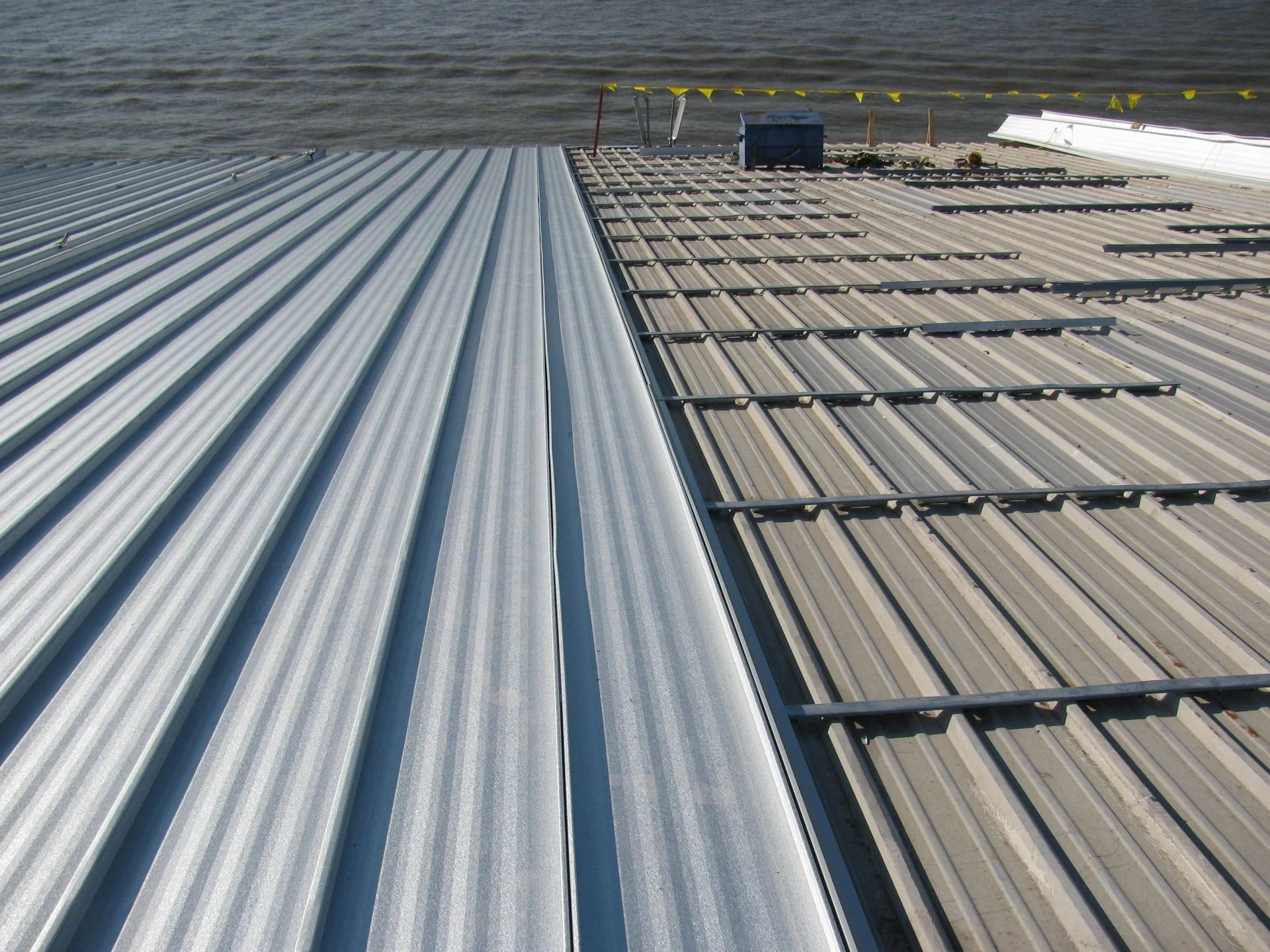
On low-slope membrane roofs, a common recover assembly places a new cover board over the existing membrane, mechanically fastened through to the deck rather than adhered to the old surface, followed by the new membrane attached to that cover board per the manufacturer's fastening spec. On metal roofs being recovered with a new low-slope membrane or a retrofit standing seam system, the assembly instead typically involves a retrofit framing or purlin system that creates a new mounting plane above the existing panels, since a membrane can't be reliably adhered to ribbed metal without that intermediate structure.
Which configuration applies depends entirely on what the existing roof is built from, and we specify the assembly type in the proposal rather than using a generic recover description that doesn't distinguish between a low-slope membrane recover and a metal roof retrofit.
Documentation for Warranty and Ownership Records
A recover project gets the same closeout documentation as a full tear-off: as-built assembly details, core sample and moisture survey data, manufacturer warranty registration, and permit and inspection records. This matters particularly for recover projects, since a future buyer, insurer, or facilities manager needs to know that a roof is a layered assembly and what's underneath the current surface.
Questions on Roof Recover and Overlay
How do you know if a roof qualifies for recover instead of tear-off?
We confirm the deck is structurally sound, insulation tests dry through core samples, and existing layer count is within code limits. All three have to hold for recover to be a viable, code-compliant option.
Is recover always cheaper than tear-off?
Usually, since it avoids demolition and disposal cost, but it's only appropriate when the underlying roof genuinely qualifies. We don't recommend recover just because it's the lower-cost option on paper.
What happens if a roof is already at the code layer limit?
Recover isn't an option at that point regardless of surface condition; a full tear-off is required to bring the roof into compliance before a new system can be installed.
Does insulation condition affect the recover decision?
Yes. Wet or crushed insulation can rule out recover even if the deck and layer count otherwise qualify, since it affects both R-value and the new membrane's attachment performance.
What documentation comes with a recover project?
The same closeout package as a full replacement: as-built details, core sample and moisture data, warranty registration, and permit and inspection records.